
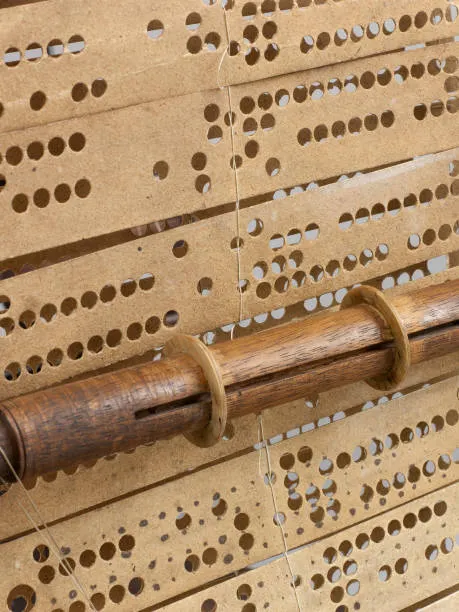
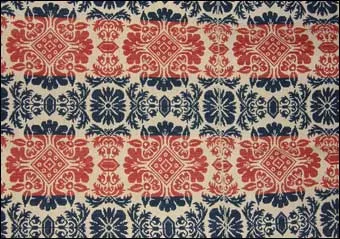
Joseph-Marie Jacquard unveiled his revolutionary Jacquard loom around 1804. The loom used a system of punch cards to control the pattern of woven cloth automatically. Instead of manually lifting and lowering threads to create intricate designs, the loom used a series of cards with holes. Each hole specified which threads should be raised, letting the loom’s operator produce complex patterns consistently.
The punch card was so powerful and innovative for several reasons:
Automation: The loom could replicate designs accurately without continuous human manipulation.
Reusability: Punch cards could be reused for multiple runs, much like software code reused to perform the same function.
Scalability: Multiple looms could run simultaneously using the same set of punch cards, allowing for mass production.
This is the beginning of digital technology because it allowed for designs to be recreated perfectly many times over with far less human input. The punch card was time and labor intensive to create but it only had to be created once and then could be replicated infinitely.
This was the first instance of encoded data telling a machine what to produce and it is shockingly similar to how our computers are able to render and duplicate images at will today.
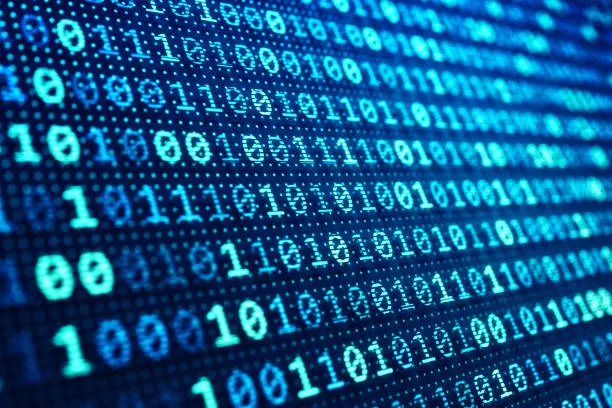
Where the loom used punched instructions to position threads, JPEG uses binary data to position color values in each pixel. When you open a JPEG file, your computer (like a digital loom) interprets encoded data to “weave” or reconstruct the image on-screen, pixel by pixel. A single JPEG file can be opened on countless devices, just as identical sets of Jacquard cards could be used across many looms.
by tracing this story from Jacquard’s punch cards to today’s JPEG format, we see how a single innovation—encoding instructions for automatic replication—continues to influence the flow of technology. The basic idea of neatly organizing and reproducing patterns remains at the heart of everything from automated weaving to digital imaging, illustrating how breakthroughs often echo through the centuries.